What Is a Right-Angled Triangle?
How to Spot One
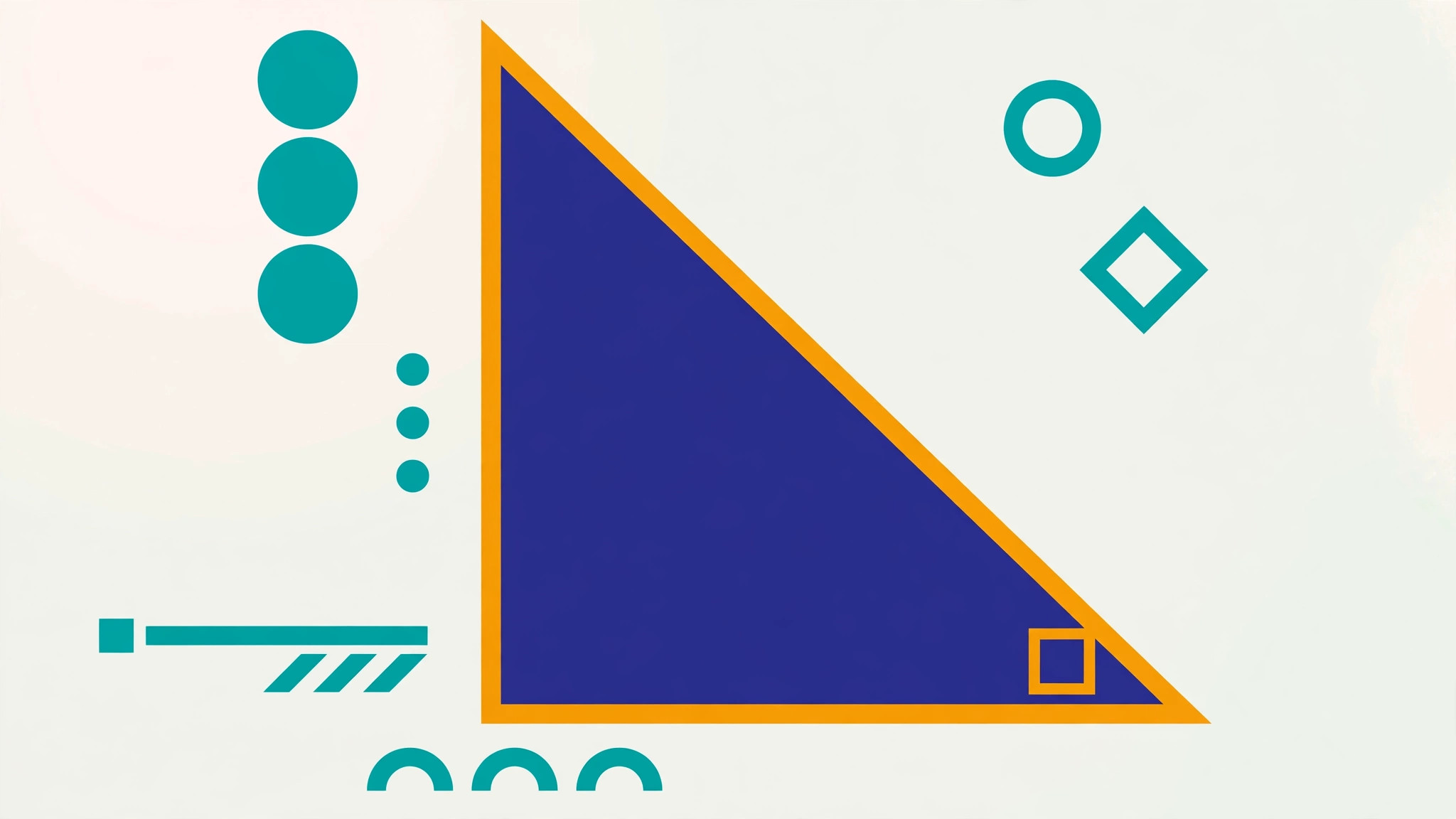
A right-angled triangle is a triangle with one angle of exactly 90 degrees, which is the same as a square corner. That right angle is usually marked with a small square in the corner of the diagram, so you can spot it at a glance. The other two angles are always acute, meaning each is less than 90 degrees, and together they add up to 90 degrees because all three angles in a triangle total 180 degrees. Right-angled triangles appear everywhere: in the corner of a book, where a ladder leans against a wall, and in the slope of a roof. Any triangle with one square corner counts, whatever its size or the way it is turned on the page.
Naming the Three Sides
The sides of a right-angled triangle have special names that make the maths easier to talk about. The hypotenuse is the longest side and sits opposite the right angle, slanting across the triangle. The other two sides are called the legs, and they meet at the right angle. When you work with an angle that is not the right angle, those legs get the names opposite and adjacent: the opposite side is across from the chosen angle, and the adjacent side is next to it. The hypotenuse keeps its name whichever angle you choose, because it is always opposite the right angle. Learning these names first saves confusion later, especially when you meet sine, cosine and tangent, which all use them.
Why They Matter
Right-angled triangles matter because they let you find unknown lengths and angles with simple rules. Pythagoras theorem links the three side lengths, so knowing any two sides gives you the third. Trigonometry links the angles to the side lengths, so knowing one side and one angle can give you the rest. Builders use them to check that walls are square: a 3-4-5 triangle gives a perfect right angle, because 3 squared plus 4 squared equals 5 squared. Surveyors, carpenters and navigators use the same ideas to measure heights and distances that cannot be reached directly, such as the height of a tree or the width of a river, from a safe place on the ground. Students meet the same triangle again in trigonometry, where the side names learned here are used to find unknown angles and distances in maps, models and real buildings.
Try it on your own numbers
The free calculator that goes with this guide:
Try the triangle calculator